 Site-Built Double Glazed Window Construction Details
How to build your own double glazed windows:
This article discusses design details for site-built double-glazed windows, including which window pane should be sealed most carefully, venting the space between window panes, the amount of space that should separate window panes, and comparing the cost of factory-built windows with site-built windows. Accompanying text is reprinted/adapted/excerpted with permission from Solar Age Magazine - editor Steven Bliss.
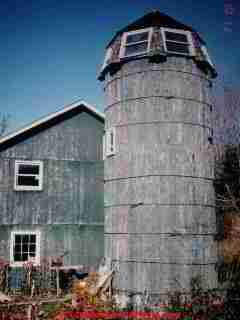
Our photograph at page top shows an interesting sloped window installation on the roof of a barn silo that had been converted to living space. Conventional wood-frame double-hung windows were set into the sloped silo roof - this was not a successful installation and the windows rapidly rotted, leaked, and disintegrated.
Green links show where you are . © Copyright 2017 InspectApedia.com, All Rights Reserved.
Site-Built Double Pane Windows
Ways to construct site-built double-pane windows
I have heard of various ways to construct site-built, double-pane windows. One way is to seal the inner pane airtight, then to fit the outer window pane somewhat loose. Other ways are similar, involving small holes to let the inner air space "breathe". What do you recommend? Also, what maximum spacing do you recommend between panes of fixed glass in a double-glazed window? - David Lile, Santa Cruz, CA
Since it is virtually impossible to achieve a hermetic seal in site-built windows (except with exotic hot melt window construction systems used sometimes in commercial window retrofits), we agree with your suggestions.
Inner window pane: Keep the inside window pane as airtight as possible to keep moist household air out of the window unit. In sealing window glass it is essential that proper allowances are made for contraction and expansion of materials over the expected temperature range -see THERMAL EXPANSION of MATERIALS.
Outer window pane: provide a moisture escape route to the outdoors once moisture does enter the space between the two window panes. A few 3/8-inch weep holes, drilled through the sill and stuffed with fiberglass or screening (to keep bugs out) is one detail we've seen. This seems preferable to a "loose" outer window pane.
Watch Out for Leaks at Drain Holes Drilled in Wood Window Frames
DJF Note: but beware: drilling through wood window frame components, if they are not properly protected from the weather and from leaks, can lead to serious window frame rot.
Recommended Space Between Window Panes in Double-Glazed Window Construction
As for the recommended spacing distance between panes of glass in a multi-glazed window, beyond 3/4-inch there is no gain in thermal performance. A one-inch double glass window unit is rated at about R-2 versus about R-1.8 for a 5/8-inch spaced window glass unit. [Specific research citations needed here.]
Window glass panes too far apart?
DJF Note: other studies have shown that if the space between window panes becomes too great, even if the window is a factory-sealed unit, thermal convection can cause air movement inside the window, increasing building heat loss during cold weather. For an explanation of convection currents and how they can cause even sealed building cavities to act as heat loss conductors.
As we detail at Convective Loops & Thermal Bypass Leaks, stack effects in buildings chill the interior walls - increasing conduction (heat) losses through them. Sealing in the home's interior will reduce infiltration, but it won't stop partitions and plumbing or electrical chases that are open to the attic from filling with cold air. A window whose glass panes are set too far apart can create these same effects, turning a window into a heat pump, sending indoor heat outdoors.
Window glass panes too close together?
DJF Note: other studies have shown that if the space between window panes is too small, even if the window is a factory-sealed unit, radiation losses from the warm inner window surface across the air space between the panes and onto the cold outer window pane will significantly reduce the window's R-value. Stick with the common window pane spacings used by window manufacturers, typically 3/16" to 3/4" between glass panes. [Specific research citations needed here.]
Window Cost Comparison: Site-Built versus Factory Made Double-Pane Windows
Incidentally, in standard window sizes, factory-sealed double-glazed window units cost about the same as two individual lites of glass you would buy to build your own site-built double-glazed windows. So unless you are retrofitting windows of odd sizes, or require extra thick windows, factory-sealed window units may be your best bet.
Our photo (left) shows a skylight that has suffered recurrent leaks at the glazing frame itself.
This unit, patched with tar and roof cement is on a New York college campus and installed in a slate roof where skylight repairs, properly performed, will reduce the frequent need to access this high and fragile slate roof.
For advice on finding and curing the cause of leaks at existing skylights and other sloped glazing, see SKYLIGHT LEAK DIAGNOSIS & REPAIR .
Here we include solar energy, solar heating, solar hot water, and related building energy efficiency improvement articles reprinted/adapted/excerpted with permission from Solar Age Magazine - editor Steven Bliss.
Original article
The link to the original Q&A article in PDF form immediately below is followed by an expanded/updated online version of this article.
The question-and-answer article above paraphrases, quotes-from, updates, and comments an original article from Solar Age Magazine and written by Steven Bliss.
Continue reading at VERTICAL GLAZING DETAILS or select a topic from closely-related articles below, or see our complete INDEX to RELATED ARTICLES below.
Suggested citation for this web page
SITE BUILT DOUBLE GLAZED WINDOWS at Inspect A pedia.com - online encyclopedia of building & environmental inspection, testing, diagnosis, repair, & problem prevention advice.
INDEX to RELATED ARTICLES: ARTICLE INDEX to ARTICLE INDEX to DOORS & WINDOWS
Or use the SEARCH BOX found below to Ask a Question or Search InspectApedia
Frequently Asked Questions (FAQs)
Try the search box below or CONTACT US by email if you cannot find the answer you need at InspectApedia.
Question: how to reduce heat loss through a big site-built window
(Jan 26, 2014) Victor said:
I have a very large "trapezoid" shaped window in my living room. It is 10 feet wide and nearly 6 feet tall on one end and 4 feet tall on the other end. The window is single pane glass. As such it is very inefficient in the winter and summer. I asked a contract or about replacing it with a double pane window and the cost was astronomical.
My thoughts are to get an on-site installation of a double glaze version consisting of three panes. this would be done by dividing the window into 3 sections on the inside with vertical dividers and "fabricating" 3 separate panes to form the second layer on the inside of the house.
Any comments on this idea or something better to reduce the heat/cooling loss through this window?
Certainly it is feasible to add one or even two layers of glazing on the indoors side of an existing fixed glass window. Depending on size, weight, location, you want to discuss the type of glass to be used, its thickness, safety glass, etc. I've done this by using a small parting strip of about 1/4". If you use a too-thick parting strip between extra layers of glazing, say an inch or more, you may get convective air loops circulating between the panes, increasing heat loss.
An alternative that is uglier but that we've discussed elsewhere is using temporary or removable solid foam insulation at night (covered with drywall to avoid a fire and code issue) or to install solar shades. But solar shades on an odd-shaped window may be difficult, pricey, or infeasible.
Ask a Question or Search InspectApedia
Use the "Click to Show or Hide FAQs" link just above to see recently-posted questions, comments, replies, try the search box just below, or if you prefer, post a question or comment in the Comments box below and we will respond promptly.
Search the InspectApedia website
Technical Reviewers & References
Books & Articles on Building & Environmental Inspection, Testing, Diagnosis, & Repair
- Solar Age Magazine was the official publication of the American Solar Energy Society. The contemporary solar energy magazine associated with the Society is Solar Today. "Established in 1954, the nonprofit American Solar Energy Society (ASES) is the nation's leading association of solar professionals & advocates. Our mission is to inspire an era of energy innovation and speed the transition to a sustainable energy economy. We advance education, research and policy. Leading for more than 50 years. ASES leads national efforts to increase the use of solar energy, energy efficiency and other sustainable technologies in the U.S. We publish the award-winning SOLAR TODAY magazine, organize and present the ASES National Solar Conference and lead the ASES National Solar Tour – the largest grassroots solar event in the world."
Steven Bliss served as editorial director and co-publisher of The Journal of Light Construction for 16 years and previously as building technology editor for Progressive Builder and Solar Age magazines. He worked in the building trades as a carpenter and design/build contractor for more than ten years and holds a masters degree from the Harvard Graduate School of Education. Excerpts from his recent book, Best Practices Guide to Residential Construction, Wiley (November 18, 2005) ISBN-10: 0471648361, ISBN-13: 978-0471648369, appear throughout this website, with permission and courtesy of Wiley & Sons. Best Practices GuideВ is available from the publisher, J. Wiley & Sons, and also at Amazon.com
vawter/PhysicsNet/Topics/Thermal/ThermExpan.html
Books & Articles on Building & Environmental Inspection, Testing, Diagnosis, & Repair
- Our recommended books about building & mechanical systems design, inspection, problem diagnosis, and repair, and about indoor environment and IAQ testing, diagnosis, and cleanup are at the InspectAPedia Bookstore. Also see our Book Reviews - InspectAPedia.
- .
Books & Articles on Building & Environmental Inspection, Testing, Diagnosis, & Repair
- Our recommended books about building & mechanical systems design, inspection, problem diagnosis, and repair, and about indoor environment and IAQ testing, diagnosis, and cleanup are at the InspectAPedia Bookstore. Also see our Book Reviews - InspectAPedia.
- Best Practices Guide to Residential Construction, Wiley (November 18, 2005) ISBN-10: 0471648361, ISBN-13: 978-0471648369, appear throughout this website, with permission and courtesy of Wiley & Sons. Best Practices GuideВ is available from the publisher, J. Wiley & Sons, and also at Amazon.com.
- .
 Carson, Dunlop & Associates Ltd., 120 Carlton Street Suite 407, Toronto ON M5A 4K2. Tel: (416) 964-9415 1-800-268-7070 Email: info@carsondunlop.com. The firm provides professional home inspection services & home inspection education & publications. Alan Carson is a past president of ASHI, the American Society of Home Inspectors. Thanks to Alan Carson and Bob Dunlop, for permission for InspectAPedia to use text excerpts from The Home Reference Book & illustrations from The Illustrated Home. Carson Dunlop Associates' provides extensive home inspection education and report writing material.
 - The Illustrated Home illustrates construction details and building components, a reference for owners & inspectors.
Special Offer : For a 5% discount on any number of copies of the Illustrated Home purchased as a single order Enter INSPECTAILL in the order payment page "Promo/Redemption" space.
- TECHNICAL REFERENCE GUIDE to manufacturer's model and serial number information for heating and cooling equipment, useful for determining the age of heating boilers, furnaces, water heaters is provided by Carson Dunlop, Associates, Toronto - Carson Dunlop Weldon & Associates
Special Offer : Carson Dunlop Associates offers InspectAPedia readers in the U.S.A. a 5% discount on any number of copies of the Technical Reference Guide purchased as a single order. Just enter INSPECTATRG in the order payment page "Promo/Redemption" space.
Building inspection education & report writing systems from Carson, Dunlop & Associates Ltd
- Commercial Building Inspection Courses - protocol ASTM Standard E 2018-08 for Property Condition Assessments
- Home Inspection Education Courses including home study & live classes at eleven colleges & universities.
- Home Inspection Education Home Study Courses - ASHI@Home Training 10-course program.


Комментариев нет:
Отправить комментарий